
Wildebeest Migration in Tanzania: The wildebeest migration is one of the most popular experiences that awaits you on Tanzania safaris. The Great Wildebeest Migration in Tanzania offers a unique and lifetime opportunity for nature lovers to have a personal encounter with millions of wildebeests while they embark on a search for places with pasture and water. The wildebeests embark on the search when accompanied by other grazers, including the Thompson’s gazelles and zebras. The Wildebeest Migration often involves wildebeests trekking over 800 km, but the entire circle comes with unique events. Besides the actual wildebeest migration, other events unfold, including wildebeest calving, rutting, and more. These occur in varying seasons, and witnessing each of them leaves lasting memories.
Where to Experience the Great Wildebeest Migration in Tanzania
The Serengeti National Park is an excellent place to witness the powerful wildebeest migration in Tanzania. The wildebeest move to varying locations depending on the season of the year. But to guide you when planning your next wildebeest migration vacation, the Ndutu plains, the Mara River region, and the Grumeti River, as well as the Central-Eastern Serengeti, offer captivating encounters of wildebeests.
The Ndutu Plains for Wildebeest Migration
The Ndutu Plains is best to explore wildebeests from December, January, and February to March. Around these months, expect to experience the peak calving season with 1000s of wildebeest assembled in the Ndutu primarily to give birth. During the birthing season, not only wildebeest calves can be encountered, but also zebras and other grazers. From December to March, the perfect places to consider for accommodation services include Ndutu Safari Lodge, Lemala Ndutu Camp, and Kusini Safari Camp.
Witness wildebeests in the Western Corridors.
The Western Corridors offer incredible encounters of wildebeest, especially between May and July when they head to the Grumeti River region. Around this period, it is possible to witness the Grumeti River crossing in Tanzania. The main safari lodges and camps to book should be around Mbalageti, Grumeti, and Kirawira areas.
The Northern Serengeti Wildebeest Migration Experience
July to October presents a unique chance for tourists to witness the dramatic Mara River crossing. The Mara River crossing becomes intense from July till October. The ideal place to book for an overnight stay around July-October to witness the Northern Serengeti migration includes the Nyasi Tented Camp, which is situated in the Lamai Wedge, Northern Serengeti National Park.
Central Serengeti Migration
Huge herds of the wildebeests embark on a movement, and several of them can be spotted on their journey to palatable areas. The Central region of the Serengeti can be explored all year round.
Eastern Serengeti wildebeests
Explore the Eastern region of the Serengeti to personally witness the large herds of wildebeests as they disperse from the North and descend southwards. The Eastern region is ideal for tourists to witness the early migration in the Serengeti National Park while it is still in its first stages.
The Great Kenya Wildebeest Migration Experience
Kenya is one of the special destinations to visit primarily for the Great Migration, and like Tanzania, there are also many other experiences to add. The Masai Mara is the right place to explore in Kenya as you witness over 1.5 million wildebeest as they traverse across the savanna plains. The most sensational of all is witnessing the dramatic river crossing at the Mara River.
Like Tanzania’s Grumeti River, the Mara River is dominated by the huge profusion of Nile crocodiles. These often pose a barrier to wildebeests and other grazers as they try to cross Tanzania’s Serengeti plains—the Masai Mara.
The best season or time to visit Tanzania for the Great Migration
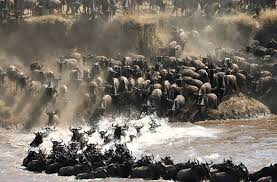 To witness the actual Great Migration in Tanzania, you can plan your vacation from around July to October. These are the peak months of the year for you to experience the best of the Tanzania wildebeest migration. The key highlights with possible chances for you to experience this world’s natural spectacle include July to October, when the wildebeest are excellently spotted in the Serengeti-Mara region.
The southeastern and Ndutu offer an exceptional chance to encounter the wildebeest from December to May. The Northern Serengeti–Lobo regions are perfect to visit in October.
Serengeti
Covering over 14,763 sq. km, Serengeti National Park became a National Park in 1951 and currently stands out as one of Africa’s oldest conservation areas. The Serengeti landscape features extensive grassy plains.
The Serengeti National Park plays a crucial role as an ecosystem, especially for the wildebeest breeding ground, and is also one of the spots to witness the powerful annual migration. It is also a designated UNESCO World Heritage Site and Biosphere Reserve, home to diverse wildlife beyond wildebeests.
Serengeti inhabitants
The diverse habitats in the Serengeti are inhabited by multiple wildlife species, including the buffalo, elephants, leopards, cheetahs, hyenas, hippos, crocodiles, antelope families, giraffes, and an estimated bird population of about 500 species.
The major birds to locate in the Serengeti include the blue-billed teal, knob-billed ducks, white-faced whistling-ducks, cape teal, spur-winged goose, Egyptian goose, fulvous whistling-duck, Schawlow’s turacos, Kori bustards, white-bellied go-away bird, white-bellied bustards, black-faced sandgrouse, chestnut-bellied sandgrouse, African emerald cuckoos, mottled swift, dideric cuckoo, Klaas’s cuckoo, pied cuckoos, Nyanza swift, and African fish eagle.
Updated Serengeti Entry Fees
Planning to visit Serengeti to witness the Great Migration, but you are unsure of the park entrance fees? Entrance fees are a must to pay for you to be given access to the Serengeti to embark on the migration tour or any safari activity. The cost of the park entry to Serengeti varies depending on the visitor category, with foreign nonresidents paying about USD 70 (adults), and children between 5 and 15 pay USD 20—this is applicable in the peak months. The off-season rates range from USD 60 for adults and USD 20 for children aged 5-15 years.
How to pack for a wildebeest migration vacation in Tanzania
Choose your items carefully to include on the packing list. On your list, consider environmentally friendly attire, a safari hat, a camera, a daypack, long-sleeved shirts, insect repellents, sunscreen, and more.
How to book the Tanzania Wildebeest Migration holiday
To join the wildebeest migration in Tanzania, book your holiday with the tour operator on the ground. Plan your migration vacation early and secure a slot through our reservation.

