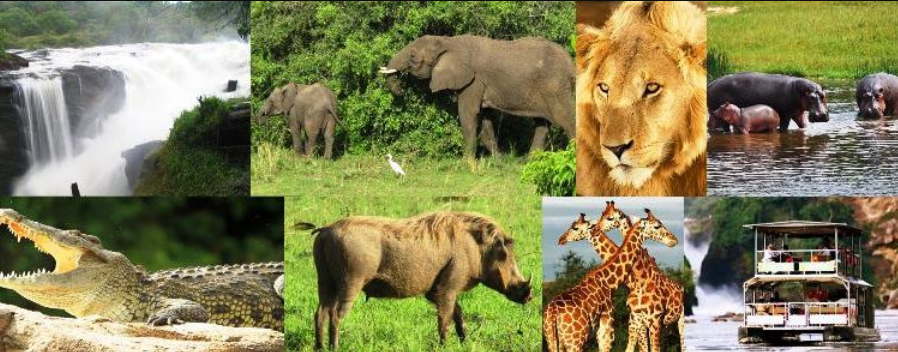
Uganda National Parks offers world-class tourism, including mountain gorilla trekking (Bwindi, Mgahinga), chimpanzee trekking (Kibale), and savanna safaris (Queen Elizabeth, Murchison Falls). Key activities include game drives, boat cruises, birding, nature walks, hiking, and cultural encounters. With all of these 10 Uganda National Parks being managed by the Uganda Wildlife Authority, you are guaranteed well-guided experiences from the beginning of your Uganda tours to the end of them. This encounter will expose you to the rare and most sought-after endangered species on earth. Among these are the African safaris’ Big Five (lions, leopards, elephants, and buffaloes). You can only spot the 5th of the Big Five (Rhino) in Ziwa Rhino Sanctuary and Bwindi Impenetrable National Park.
Uganda is a top destination for ecotourism, featuring 10 national parks managed by the Uganda Wildlife Authority. It is a landlocked East African nation bordered by Kenya, Tanzania, Rwanda, South Sudan, and the DRC, with its capital called Kampala. With a population of nearly 50 million, it is a diverse country featuring Lake Victoria, the Nile River source, and rich diversity, including mountain gorillas in Bwindi Impenetrable National Park. Uganda is a member of the East African Federation and is one of the countries on the African continent that is gifted by nature with amazing national parks. This prompted the British premier to declare it “The Pearl of Africa” in 1908 and hence the best African safari destination, highlighting the country’s breathtaking landscapes, varied flora and fauna, and vibrant nature.
The list of the 10 Uganda National Parks
Bwindi Impenetrable Uganda National Parks
Bwindi Impenetrable National Park is located southwest of Uganda on the western edge of the East African Rift Valley bordering DRC, and it contains nearly 400 species of plants that form the vast impenetrable forest, reflecting the dense and tangled vegetation that makes passage difficult, requiring ranger guides to cut paths for trekkers. The park is proudly known to be home to nearly half of the world’s remaining population of endangered mountain gorillas (about 459). The park also encompasses one of Uganda’s oldest and most biologically diverse rain forests, which is home to over 119 other mammal species besides the mountain gorillas and 350 species of birds, including 23 Albertine Rift endemics, as well as at least 200 butterfly species, including eight Albertine Rift endemics.
The park initially was a home to the Batwa (pygmy) people. However, in 1991 it was gazetted as a national park, and the Batwa people were evicted from the forest. Bwindi Impenetrable National Park was declared a UNESCO World Heritage Site in 1994 due to its exceptional biodiversity, and thus gorilla trekking is the major safari activity in the dense forests of the park.
Activities in Bwindi Impenetrable National Parks
Bwindi Impenetrable National Park holds amazing attractions every traveler on a Uganda holiday shouldn’t miss out.
Gorilla trekking in Bwindi Impenetrable National Park
Bwindi boasts almost 50% of the gorillas living on earth; that is to say, it holds 459 gorillas out of the 1,063 mountain gorilla population on earth. The park holds over 50 gorilla families, and out of these, 18 are fully habituated and open for Uganda gorilla trekking. These gorillas are typically spotted in four sectors of Bwindi, that is, Buhoma in the North, Ruhija in the East, and Nkuringo and Rushaga in the South.
Gorilla habituation in Bwindi Impenetrable Uganda National Parks
Bwindi is the only park where gorilla habituation is carried out and is done in the Rushaga sector on the Bikinga gorilla family. This memorable encounter allows you to spend more hours with gorillas in the jungle, and usually visitors spend over 4 hours with the gentle giants.
Game drive and nature walks
Other than the gorillas, the park protects different primate species that are easily seen on a nature walk or during a game drive, for example, monkeys, olive baboons, and wild chimpanzees, and the wild animals include elephants, duikers, bush pigs, leopards, and buffaloes, among others.
Birding in Bwindi Impenetrable Uganda National Parks
The park holds over 350 bird species, with over 90% of the Albertine endemic bird species, and among these are the purple-breasted sunbird, Rwenzori batis, handsome francolin, regal sunbird, great-blue turaco, double-toothed barbet, and yellow-rumped tinkerbird. Therefore, for bird lovers on trips in Uganda, bird watching in Bwindi shouldn’t miss out on your itinerary.
The Batwa culture
The park initially was a home to the Batwa (pygmy) people. However, in 1991 it was gazetted as a national park, and the Batwa people were evicted from the forest. They used to live in trees and caves; they used to hunt for food and also used herbal medicine for survival. They also worshipped their spiritual leaders for protection.
Queen Elizabeth National Parks
Queen Elizabeth National Park is one of Uganda’s oldest and most famous diverse conversation areas, located in the western part of the country. Established in 1952 and renamed in honor of Queen Elizabeth II of Great Britain after her visit in 1954, the park covers approximately 1978 square kilometers. The park stretches from Lake George in the northeast to Lake Edward in the southeast, linked by the scenic Kazinga Channel. It lies near the border of the Democratic Republic of the Congo and is surrounded by other protected areas such as Virunga National Park, Kibale National Park, and Kyambura Game Reserve.
Activities in Queen Elizabeth Uganda National Parks
Chimpanzee Trekking in the Kyambura Gorge
Kyambura Gorge is located within the northeastern part of Queen Elizabeth National Park, featuring a 100-meter gorge in the middle of the savanna. This offers an 80% chance of sighting habituated chimpanzees in a unique, deep “valley of the Apes. Chimpanzees are the gorge’s headline inhabitants. These are a great type of ape closely related to humans, sharing about 98% of the DNA with people.
During trekking, you will meet the habituated family of 23 members led by an alpha called Kihango. With the restrained nature of the forest, it is easy to find the chimpanzees by sound, chimpanzee dung, leftover fruits, and housing nests. The Kyambura Gorge landscape is among the most impressive you will find in Uganda and is swarmed with rich wildlife biodiversity that comprises primates, wild animals, and birds.
Bird watching in Queen Elizabeth National Parks
Birdlife in Queen Elizabeth National Park is exceptional, with more than 600 bird species recorded, making it one of the top birding destinations in Africa. These include flamingoes, African fish eagles, pelicans, kingfishers, corncrakes, blue turacos, papyrus canaries, white-tailed hawks, African broadbills, black-bee eaters, and many other waterbirds along the Kazinga Channel. The wetlands, savannah grasslands, forests, and crater lakes provide varied habitats that support this rich avian diversity.
Game drives Queen Elizabeth Uganda National Parks
Visitors to Queen Elizabeth National Park can also enjoy game drives that are best done in the morning (6-9 AM) and late afternoon (4-7 PM), when wildlife is most active and temperatures are cooler. They are normally done in the Kasenyi sector, where lions, leopards, spotted hyenas, herds of elephants, and buffaloes are spotted. It is best during the dry season for clear views due to shorter vegetable and easier road access. During day drives, we can use safari vehicles for standard viewing of tree-climbing lions in the Ishasha sector, a rare species that is only in Queen Elizabeth National Park.
Boat cruise in Queen Elizabeth Uganda National Parks
One of the park’s most popular activities is the boat cruise along the Kazinga channel accessed via operators near the Mweya or Katunguru landing site. This natural waterway connects Lake George to Lake Edward and offers visitors close-up views of hippos, crocodiles, elephants, and a wide variety of water birds. The waterway lasts 2-3 hours with morning/afternoon/evening departures for scenic sunset views. It is best done during the dry seasons (June-Sept, Dec-Feb), which often offers better wildlife viewing as animals gather at the water.