
Living in the dense tropical forests of Africa: In the dense forests of Africa that were undisturbed during the tectonic movement of the earth is where we find the rare and less endangered species of the ape (mountain gorillas). Gorillas are among the five great apes in the world that inhabit the Virunga Conservation Areas of countries like Rwanda, the Democratic Republic of Congo, and Uganda.
However, in countries like the Democratic Republic of Congo and Rwanda, they inhabit the low areas/lakes/primary forests of the eight volcanic mountains of Mount Muhabura, Mount Mgahinga, Mount Sabyinyo, Mount Bisoke, Mount Nyamuragira, Mount Nyiragongo, Mount Karisimbi, and Mount Mikeno. This provides less food for the giant apes that will not climb high tops of the mountains that are freezing due to the high level of altitude, whereas animal reproduction in the wilderness is based on the amount of food in an area.
Bwindi Impenetrable National Park in Uganda has the biggest number of gorillas in the world. This is because the dense forests of 331 square kilometers cover the rolling hills of the Kigezi region bordering Queen Elizabeth National Park on the northern side, the Democratic Republic of Congo, and some other districts of Uganda.
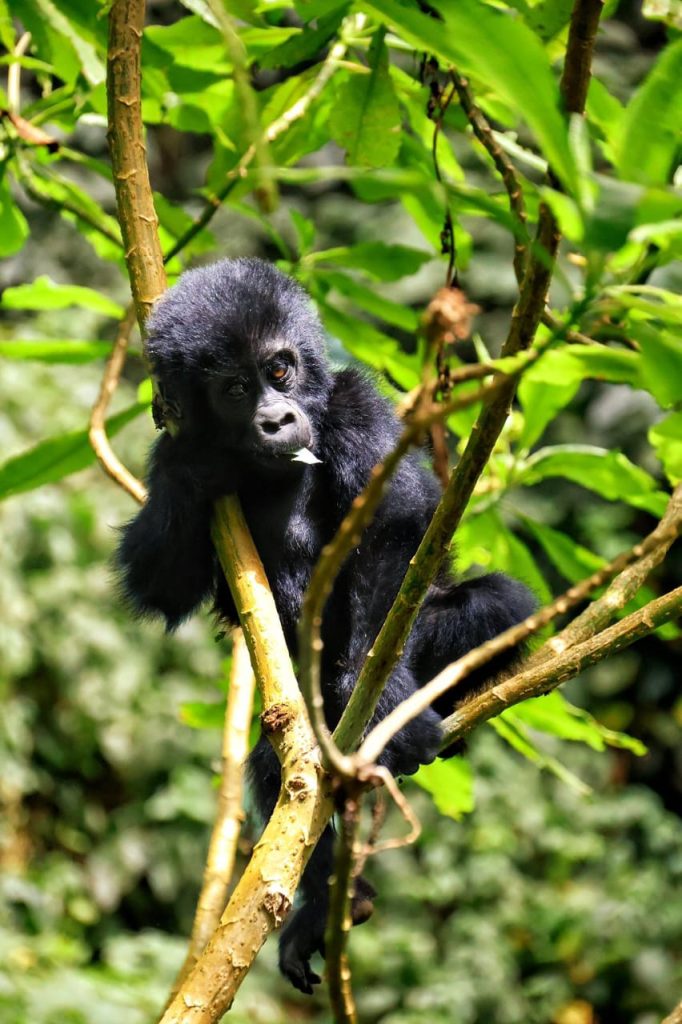
The park harbors over 450 numbers of gorillas, and this makes Uganda have the biggest number of gorillas in the world. A few of these living in different families are habituated and ready to be tracked while in their wilderness. In a family it includes the mothers, babies/juveniles, black back, and silver back. This makes a complete gorilla family that will be led by a silverback, ready to protect the family or its members. By visiting these giant apes of Africa, you will have a chance to experience the dense tropical forests of Africa that are hard to penetrate, allowing the rangers, with the help of the porters, to create your way through while cutting the vines, grass, and other plants to make sure that you can view or see these animals.
The forests are inhabited by other animal species like the African forest elephants, duikers, species of monkeys like the olive baboons, black and white colobus monkeys, red-tailed monkeys, red colobus monkeys, galagos, bushbabies, l’hoest monkeys, gray-cheeked mangabeys, and many more others. It also harbors a number of reptiles, birds, moths, and butterflies

