
Golden Monkey Trekking in Rwanda: This is one of the most affordable primates encounters in Rwanda. From the park headquarters at Kinigi, near Musanze, you walk into the bamboo forest on the Virunga volcano slopes. With a ranger and spend about an hour with a habituated troop. The golden monkey is an endangered species found only in this volcanic region of central Africa. The price of a gorilla permit is lower than the habituation permit. The hike is often easier. This guide covers what happens on the trek, how permits work, what to prepare for, and how the experience compares with gorilla trekking.
What makes golden monkeys worth the trek?
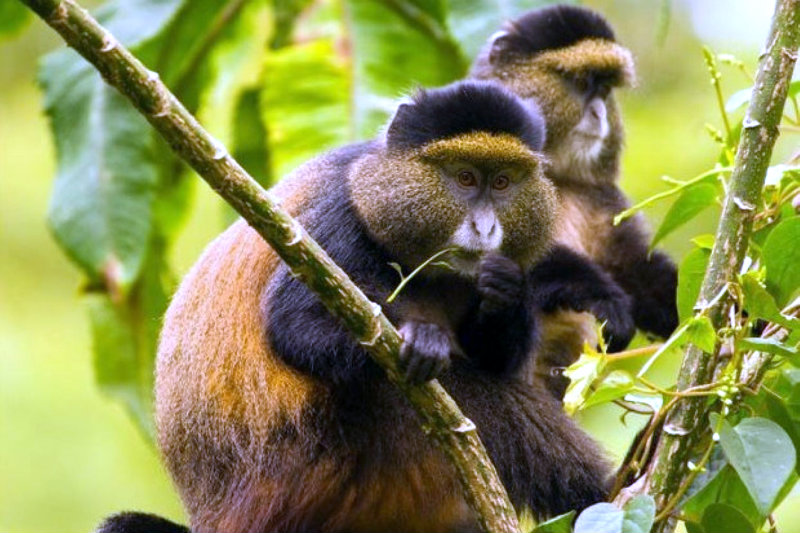
The golden monkey is a guenon with a golden-orange patch across its back and cheeks, set against dark limbs and tail. Its range is restricted to the bamboo and montane forest of the Virunga volcanoes. Which Rwanda shares with Uganda and the Democratic Republic of Congo. The species is listed as endangered, mainly because its habitat is small and under pressure from the farmland around the park.
Golden monkeys live in large troops and spend much of the day feeding on bamboo shoots, leaves, and fruit. They are restless, noisy, and quick, so the encounter feels very different from sitting quietly beside a gorilla family. Expect animals leaping between bamboo stems, squabbling over food and moving constantly, with the youngsters often the most entertaining.
How a golden monkey trek works
The day usually begins early at the Volcanoes National Park headquarters in Kinigi, where rangers brief visitors on the rules and assign them to a group and guide. A short drive takes you to the trailhead, and the walk starts across farmland before entering the bamboo zone. How long you walk depends on where the troop has moved that morning. Some groups are found within an hour, others take longer, and the ground can be muddy and steep in places.
Once the monkeys are located, you have about an hour with them. Guides ask visitors to keep a respectful distance, avoid sudden movements, and not eat or drink near the animals, and flash photography is not allowed. The monkeys are habituated, so they tolerate people nearby, but they are still wild and will not pose. Most treks are finished by around midday, which leaves the afternoon free for other activities.
How hard is the hike?
Difficulty depends mostly on where the troop is that day. In the bamboo zone you are already at altitude, so even a short climb can leave you short of breath. The wet ground slows everyone down. Rangers set a pace that suits the group, and you can tell your guide if you need to go slower. Visitors worried about the terrain can ask the park or their operator about porters and assistance before booking. Most healthy walkers manage the trek comfortably, and it is generally gentler than the longest gorilla hikes.
Permit cost and booking for Golden Monkey Trekking in Rwanda
Operators report that golden monkey permits cost about US$100 for foreign non-residents in 2026. The Rwanda Development Board (RDB) sets the actual price, and it can change, so confirm the figure before you pay. The permit generally covers park entry and a ranger guide. Transport to Kinigi, accommodation, meals, tips, and any porter are paid separately.
You can book through a licensed tour operator or through the RDB’s online system. Golden monkey permits are usually easier to get than gorilla permits; therefore, it is still wise to reserve ahead during the busy months from June to October. Booking early also lets you build the trek into a sensible schedule instead of fitting it around whatever is left.
For context, Rwanda charges US$1,500 per international visitor for a gorilla permit. That gap is why golden monkeys appeal to travelers on a tighter budget and to anyone who wants a second primate day without a second large permit.
Golden monkeys or gorillas?
The two treks are not direct substitutes, and many visitors do both. Volcanoes National Park has 12 habituated gorilla families, with eight permits issued per family per day. Gorilla treks are the headline experience, but they cost far more, sell out faster, and can involve a long, steep hike depending on where the family has gone. Golden monkey treks cost a fraction of that and usually involve less walking, which makes them easier for less fit visitors or those on a limited budget.
The encounters also feel different. Gorillas are calm and powerful, and an hour with them can feel almost still. Golden monkeys are fast and playful, which is fun but hard to photograph. If you can afford only one trek and want a once-in-a-lifetime sighting, gorillas are the stronger choice. If you want a lively wildlife encounter in a beautiful forest at a manageable price, golden monkeys are an excellent alternative.
Best time for Golden Monkey Trekking in Rwanda
Rwanda’s drier months, roughly June to September and December to February, give firmer trails and clearer views of the volcanoes. The wetter periods, roughly March to May and October to November, bring more mud and rain, and bamboo trails can become slippery. Golden monkeys can be seen all year, so a wet-season trek is still worthwhile if you are prepared, and the forest is at its greenest then. Mornings at altitude are cool in any season, and weather in the volcano region can change quickly.
What to pack
A moderate level of fitness is enough for most people, though the altitude and terrain make it harder than an ordinary walk. Wear sturdy boots with good grip, long trousers, and a waterproof jacket. Gloves help with stinging plants and slippery stems.
Carry water, a light snack to eat before reaching the monkeys, a hat, sunscreen, and a camera with a fast shutter speed, since the animals rarely stay still. Local porters can usually be hired to carry your bag, which makes the walk more comfortable and supports the community.
Why the permit matters for conservation
Golden monkeys share their habitat with mountain gorillas, and the same protection work benefits both. Rangers patrol the park, monitor habituated groups, and guard the forest edge, where farmland presses close to the boundary.
Permit fees help pay for this, and community benefit schemes channel part of tourism income to the villages around the park. That link between visitors and local livelihoods is a large part of why the forest has stayed protected, so the permit is best understood as a contribution to conservation, not only an entry fee.
Getting to Kinigi and planning around the trek
Volcanoes National Park lies near Musanze in northern Rwanda. The drive from Kigali typically takes two to three hours depending on traffic, so most visitors spend a night nearby and trek the next morning.
A comfortable plan is two or three nights in the Musanze area, with golden monkey trekking on one day and a gorilla trek or another activity on the next. Other options include the hike to Dian Fossey’s grave, climbing Mount Bisoke, visiting Lake Burera and Lake Ruhondo, and exploring the Musanze caves. Mgahinga Gorilla National Park in Uganda also offers golden monkey trekking, which is useful if your trip is based in southwestern Uganda.
Golden monkey trekking in Rwanda offers an exciting opportunity to encounter endangered primates in the bamboo forests of Volcanoes National Park. With its thrilling wildlife encounters, views of volcanoes, and expedition fees significantly lower than gorilla trekking, this is a must-see as a highlight of a safari in Rwanda.

