
Shoebill Tracking in Mabamba Swamp
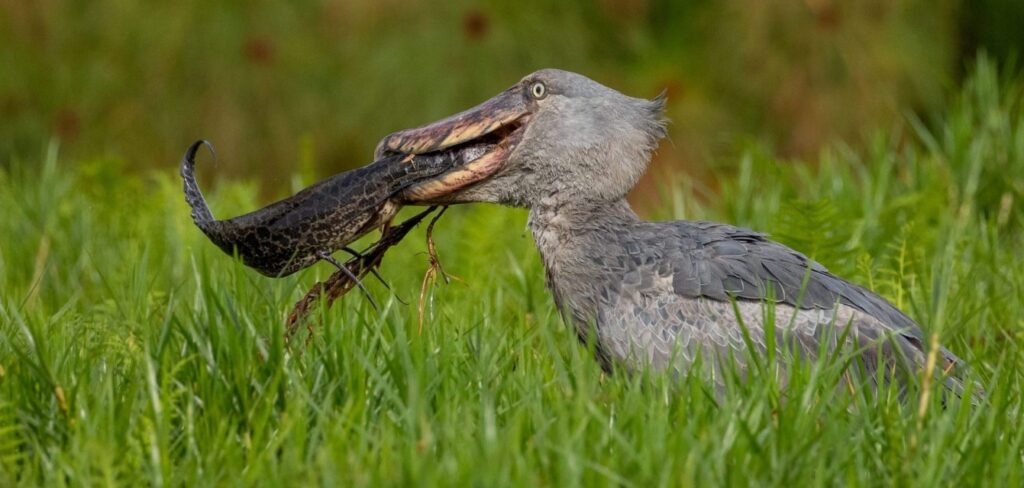
Shoebills in Mabamba Swamp is when, on a birding excursion to Uganda, you will come face-to-face with this prehistoric giant bird using binoculars. A shoebill in Mabamba Swamp is when the shoebill in the Mabamba Swamp stretches to showcase its 8-foot wingspan and welcomes you to its swamp. Mabamba Swamp is located on the northern shore of Lake Victoria and is just 12 km west of Entebbe.
Mabamba Swamp was awarded the status of a ‘Wetland of International Importance’ because it contains globally threatened species; therefore, it is recognized as an Important Bird Area (IBA). Mabamba will absorb birders and non-birders alike since the wetland is Uganda’s most important birding site and is home to over 300 bird species.
The shoebill stork is a large bird that stands up to 1.5 m (5 ft) tall, weighing in at 5-7 kg and with a wingspan of 2.3 m (7.5 ft). This strangely beautiful bird is a solitary animal with a silent and stoical approach to hunting for its favorite catch, which is the mudfish. The swamp is named after the lungfish, which inhabit its waters, and they form the staple of the shoebills’ diet.
How shoebills feed in the Mabamba swamp.
The shoebill is named after its signature feature and its resemblance to a shoe. It has sharp edges and a hook at the tip, which allows the bird to grab, grip, and kill live prey, and their bill is the third longest of all living birds. The shoebill can stand still for a long time, even hours, watching out for movement in the mud before rapidly launching forward to grab a lungfish.
Once the prey is in sight, the bird quickly strikes, with 60% of attempts resulting in a kill. Their large, sharp beak allows the shoebill to hunt larger prey than is typical for wading birds. They primarily eat fish, showing a preference for lungfish, but will also prey on frogs, water snakes, madfish, and monitor lizards.
How the shoebills in Mabamba swamp bleed.
Shoebills normally, when breeding, have fewer than three nests found per square kilometer, and even when paired up in the breeding season, they still appreciate their own space and will feed at opposite ends of their territory and hatch more than one chick, and they only raise one. The younger chicks are usually left to die, unless the eldest is weak or doesn’t survive. The adult cares for a chick between 8 months and a year, which provides an ideal breeding habitat.
Other activities were carried out while tracking shoebills in Mabamba Swamp.
Birdwatching
Mabamba is also a home to many other majestic birds, including the African marsh harrier, herons and egrets, the malachite kingfisher, the African jacana, the black crake, the swamp flycatcher, and the long-toed lapwing. Bird watching is the dominant activity in Mabamba Swamp and is one of the main reasons why many visitors come to the area. You will be able to spot and identify the most elusive species, which will help you enhance your understanding of the ecosystem.
Cultural Interaction
The best way to experience life after canoeing in Mabamba Swamp is by interacting with the local community, visiting the nearby market, or learning how traditional canoes are crafted. This activity is led by the local expert guides and paddlers who have intimate knowledge of the village, ensuring both safety and incredible sightings.
Travel Tips for tracking Shoebills in Mabamba Swamp
The best way to experience Mabamba is by traditional dugout canoe, silently gliding through the narrow water passages as the mist rises from the swamp. Local guides are essential to navigate the dense, narrow channels of wetlands like Mabamba. Shoebill tracking typically takes 1-3 hours inside the swamp, plus travel time. The guests are required to carry binoculars, a camera with a zoom lens, sunscreen, a hat, insect repellent, and waterproof shoes during shoebill tracking.
Best time for tracking shoebills in Mabamba Swamp.
The best time to track shoebills in Mabamba swamps is during the dry seasons, from December to February and from June to August. During these periods, water levels are low, which makes it easier to spot shoebills as they hurtle along the exposed shores. Early mornings or late afternoons are particularly ideal for sightings, as shoebills are more active during these cooler, quieter parts of the day.
Mabamba is also a home to many other majestic birds, including the African marsh harrier, the glossy ibis, and the long-toed lapwing.
How to get to Mabamba Swamp for shoebill tracking.
From Entebbe a one-hour road trip will take you to the village of Mabamba via Nakawuka-Kasanje, where a local boatman will take you out in local dugout canoes. This is a lovely half-day excursion that works well when you have a few hours between flights. It is also possible to travel to Mabamba via boat across Lake Victoria. The scenic journey gives you more time to appreciate the beautiful birds.
Where to stay around Mabamba Swamp.
There are top accommodation choices around Mabamba Swamp, and their areas are designed for birding enthusiasts, particularly for spotting the elusive shoebill stork, and these hotels include the following: The Protea Hotel Entebbe, Karibu Guesthouse, The Boma Hotel, The Lake Victoria Serena Hotel, Nkima Forest Lodge, Buvi Lodge, and Mabamba Lodge.
Conclusively,
Mabamba feels like a true retreat into nature, untouched, and deeply peaceful. Don’t miss the chance to witness the majestic shoebill stork and the experience of exploring one of Uganda’s richest wetland ecosystems. You can also pair your swamp tour with visits to nearby attractions like the Entebbe Botanical Gardens and the Uganda Wildlife Education Conservation Centre (UWEC).

