
Uganda is a haven for primate enthusiasts, gorilla photographers, and adrenaline seekers. With more than half the World’s population of mountain gorillas in the wild and two incredible gorilla trekking National Parks to explore, gorilla tours in Uganda offer some of the greatest opportunities in the World to get up close and personal with one of Africa’s most sought-after wildlife species in the wild.
Few wildlife experiences match the adrenaline rush of meeting face-to-face with silverback gorillas (adult males) or seeing a playful baby gorilla in the jungle, followed by the silent gaze as they go about their daily routines. Gorilla trekking in Uganda has less to do with meeting face-to-face with the endangered primates; it has more to do with reading the rainforests and listening to its whispers and working with experienced Ranger guides able to listen and interpret the jungle’s hidden secrets.
For visitors on a primate safari, gorilla trekking is what makes this trip into the jungles all the more special, involving an added level of understanding (skill, patience, hard work, luck, and the assistance of expert Ranger guides).
Whether you are considering an exclusive gorilla trekking safari in Uganda, a primate safari, or a packaged Uganda primate and wildlife safari, you are going to have an array of options. You are simply a few clicks away from enjoying your long-awaited adventure from the volcanic slopes of Mgahinga Gorilla National Park to the dense rainforest of Bwindi National Park.
National Parks renowned for Gorilla Trekking in Uganda
Bwindi Impenetrable National Park
Renowned for its high mountain gorilla density (almost half the World’s population of these Giant Apes), Bwindi Impenetrable National Park is a must-visit for anyone seeking a gorilla trekking safari in Uganda. The 32100-hectare landscape combines dense ancient tropical rainforest with swamp/marshland, deep Valleys, montane, and lowland forest, offering natural habitat to over 500 mountain gorillas living in different areas of the Protected Area.
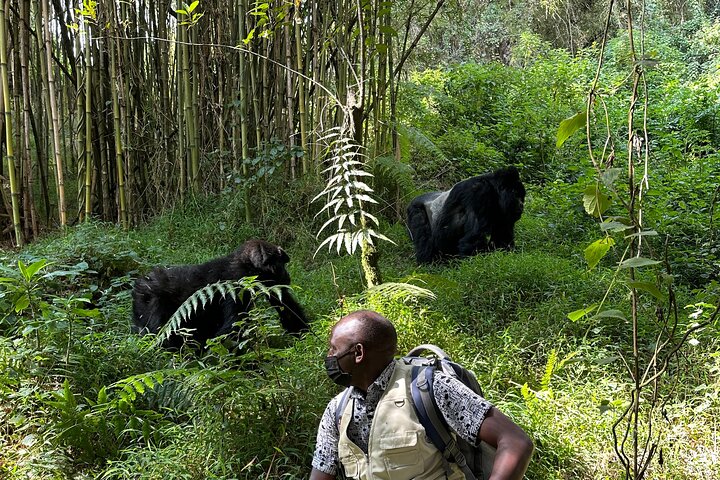 Divided into four trekking sectors (Rushaga, Buhoma, Ruhija, and Nkuringo), Bwindi’s habituated gorilla families can be tracked according to any of these areas. So far, over 25 gorilla families have been fully habituated; hence, only about 200 gorilla families are issued each day (based on 8 gorilla permits for each habituated gorilla family). With a gorilla permit, costing $800 per person, you will have access to any of these habituated gorilla families and get to spend at least 1-6 hours tracking and one hour watching and taking photos.
When choosing accommodations for gorilla trekking in Bwindi, bear in mind that the place you stay is within the same sector/region of tracking or close by. For instance, you can stay in Buhoma and trek in Ruhija too (one hour away), or stay at Rushaga and track in Nkuringo or vice versa.
Mgahinga Gorilla National Park
As Uganda’s smallest National Park, few visitors believe that something incredible can come out of Mgahinga Gorilla National Park, but let us burst your bubble; Not only can you get the chance to track mountain gorillas, but also have an opportunity to see the endangered golden monkeys if interested.
This 3400-hectare Protected Area has the smallest population of these Giant Apes, currently standing at about 40 individuals, and a chance to trek its only habituated gorilla family known as “Nyakagezi”.
Permits for gorilla trekking in Mgahinga Gorilla National Park cost the same as those in Bwindi Impenetrable National Park, but the only difference is that only 8 permits are issued per day, and the park isn’t divided into trekking sectors/regions.
Best time to visit Uganda for gorilla trekking
The prime season for Uganda gorilla trekking adventures runs from June through September, and December through February, when the weather remains pleasant and forest trails are more favorable to navigate while searching for the Giant Apes. During these warmer months, daytime temperatures range between 21 and 23 degrees Celsius, and rainfall levels drop below the annual range of 1400 to 1900 mm per year. These conditions favor gorilla trekking adventures, which are done on foot.
Many visitors avoid the wet season (March to May and November). Heavy rains fill the forest floor, hence making navigation difficult and risky. Also, the forest cover increases due to increased precipitation levels, but this is also the low season, meaning there are chances of enjoying discounted rates, especially on accommodations.
Required permits and documentation for Uganda Gorilla Trekking tours
Accessing Bwindi Impenetrable and Mgahinga Gorilla National Parks for the purposes of searching for the endangered mountain gorillas requires valid gorilla permits and proper documentation. Foreign non-resident and foreign resident visitors need valid passports, while East African Community resident tourists must carry Government-issued photo identification.
One of the reasons why you need this is because gorilla permits are issued based on these three categories- Foreign non-resident (permits cost $800 per person), foreign resident ($700 per person), and East African Community Citizens (Shs. 300,000 per person).
The Uganda Wildlife Authority issues over 200 gorilla permits for Bwindi Impenetrable National Park and 8 gorilla permits for Mgahinga Gorilla National Park.
Apply for gorilla permits via credible Tour Operators/Tour Companies who also handle documentation as part of their gorilla safari packages. Processing typically lasts 24 to 48 hours; hence not advisable to attempt same-day applications.
Tips for planning the best gorilla trekking safari in Uganda
- Choosing the right season for the adventure
While gorilla trekking is available all year round, the best time to go for a gorilla safari is during the dry months (June to September) when rainfall levels have reduced and forest trails are more comfortable to navigate while searching for the Giant Apes.
- Book in advance
Popular gorilla trekking destinations like Bwindi Impenetrable National Park get fully booked during high seasons, with gorilla permits and accommodation availability being a challenge. For this reason, it is advisable to secure your gorilla safari package early to avoid last-minute disappointments or missing out on your dream.
- Park smartly
Gorilla trekking essentials such as sturdy hiking boots, long-sleeved shirts, long safari pants, a rain jacket, a waterproof backpack, a camera, a pair of binoculars, comfortable clothing, and an insect repellent will enhance your Uganda gorilla trekking experience.
What to pack for a successful Uganda gorilla trekking expedition
Packing smart for your Gorilla trekking safari in Uganda makes the difference between miserable endurance and comfortable, as well as unforgettable exploration. For this reason, comfortable, lightweight, quick-dry clothing in neutral tones (brown, khaki, and dark blue) works perfectly for mountain gorilla territory safety while avoiding brightly-colored clothing that spooks wildlife.
Talking of essential clothing, you will need safari pants and a long-sleeved shirt for protection from the sun, insects, and unpleasant vegetation, a waterproof rain jacket for the unpredictable rains, a wide-brimmed hat with a chin strap, comfortable hiking boots with good grip and ankle support, extra cotton socks, and underwear.
Technical equipment such as a non-flash camera with extra batteries, memory space, and a telephoto lens, as well as a pair of binoculars, is handy. Additionally, you will need power banks or portable chargers and waterproof storage bags.
Don’t forget practical accessories that include a reusable water bottle, energy-giving snacks, a flashlight, and a waterproof watch.
Personal care items such as sunscreen, insect repellent, a first aid kit, personal medications, and toiletries shouldn’t be missed during your gorilla trekking safari.
Leave unrequired valuables such as bright jewelry, perfumes, and others. The jungles, which are the mountain gorilla natural habitats, require practical preparation, not fashion statements.

