
You must have heard about the mountain gorilla habituation experience in Bwindi Forest! The activity is about training wild gorillas to make them familiar to people. adventure is about Wild mountain gorillas are generally human-averse; they often avoid humans and respond to human encounters by running off and retreating to cover in the dense rainforest. You would therefore expect visitor viewing of mountain gorillas to be unpredictable, intermittent, and short-lived. Yet in recent years, mountain gorilla trekking has become one of the major recreational activities for millions of primate enthusiasts across the Globe, and Gorilla Tourism has emerged as one of the most thriving adventures.
Therefore, how can these two factors- far-reaching mountain gorilla intolerance of visitors as well as comprehensive tourist observation of the Giant Apes be made possible? Have you ever wondered why mountain gorillas don’t hide from safari goers? When you are interacting with them (taking photos and learning about their behavior) in their natural habitats in East-Central African forests, the answer is that wild mountain gorillas are only visited/trekked because they have been made viewable/visitable through human intervention in a process known as “Habituation.”
Years before any plans are drawn for new accommodations, teams from National Park Rangers, researchers, trackers, conservationists, and other safari partners first hit the ground to introduce the endangered mountain gorillas to human presence during habituation. This process usually lasts 2-5 years, depending on whether the members of the gorilla family were part of an originally habituated family or not.
At the start of Gorilla Habituation, researchers and other members of the team observe these Giant Apes from a distance of at least 100 meters for months. Gradually, the Rangers reduce the distance while imitating Gorilla Vocalizations. The team has to build trust with the mountain gorillas, as silverback acceptance is crucial; hence, researchers use submissive postures.
It might interest you to know that visitors have an opportunity to visit a semi or partially habituated gorilla family during the Gorilla Habituation Experience, hence expect wilder and more timid mountain gorillas compared to those you will visit during the standard gorilla treks.
Where to do the Gorilla Habituation Experience
To give you some background, mountain gorillas- with a population of less than 2000 individuals in only three countries- Uganda, Rwanda, and the Democratic Republic of Congo these Giant Apes are one of the most sought-after wildlife species in the African Continent. Thanks to mountain gorilla protection and conservation efforts launched in the 1970s, the World’s mountain gorilla numbers are steadily increasing. Among the four National parks sheltering these Giant Apes, Bwindi Impenetrable National Park leads with the highest number of mountain gorillas, estimated at about 500 individuals, followed by Rwanda’s Volcanoes National Park.
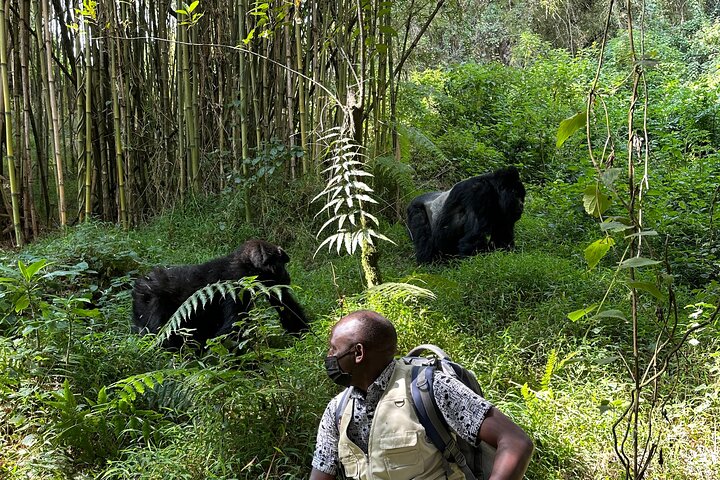 Uganda is undoubtedly your best (and only) bet if you are hoping to catch a glimpse of semi-habituated mountain gorillas during the “Gorilla Habituation Experience”. While there are two gorilla trekking locations in this country, this experience is only possible in the southern sector of Bwindi Impenetrable National Park (in the Rushaga sector).
There is only one Gorilla Family available for the Gorilla Habituation Experience, and it is trekked by only four people/visitors each day. That said, only four gorilla permits are issued each day by Uganda Wildlife Authority for this life-changing adventure.
Why is Gorilla Habituation Experience unique? Well, unlike standard gorilla treks, where visitors only have one hour to watch and take photos of these Giant Apes after several hours of searching for them in their natural habitats, you have up to four hours with the mountain gorillas during the Gorilla Habituation Experience.
What does the Gorilla Habituation Experience entail?
Here are some of the most essential things to keep in mind when planning a Gorilla Habituation Experience in Uganda. First and foremost, these treks don’t guarantee mountain gorilla sighting.
That’s why having knowledgeable trackers moving ahead and finding the location of these Giant Apes and communicating with the Ranger guides is essential for these experiences.
A Gorilla Habituation Experience adventure in Uganda often means rising at the crack of dawn, walking or driving to the Park Headquarters (depending on the location of your accommodation) for registration and briefing. You will need to drive to the trailhead of Bikingi Gorilla Family and start the search for these Giant Apes with the guidance of trackers who move ahead to find the location of mountain gorillas and communicate with Ranger guides on where to find them.
These treks last anywhere between one and six hours, depending on the locations of the Giant Apes. Once sighted, you will have four hours to listen and take photos as Ranger guides provide information on mountain gorilla behavior.
Gorilla Habituation Experience permits
A permit, costing $1500 per person for foreign non-residents, $1000 per person for foreign residents, and shs. 750,000 per person for East African residents is required to undertake the Gorilla Habituation Experience in Uganda.
While these permits are only issued by Uganda Wildlife Authority, you have to book through a Travel Agent/Tour Operator. You will be required to provide information on full name, passport number, and nationality, Age, and preferred trekking date/s.
When is the best time to go for the Gorilla Habituation Experience in Uganda?
The ideal months for going for the Gorilla Habituation Experience in Uganda are January, February, June, July, August, September, and December, as temperatures are higher and rainfall levels are reduced.
As temperatures rise and rainfall levels reduce, the forest floor becomes drier, with reduced foliage. With these conditions, the forest is quite comfortable to navigate and search for the Giant Apes during the Gorilla Habituation Experience. However, this season is also the high season, which means permit and accommodation availability are challenging, especially for last-minute bookings. Therefore, we recommend a one-year booking of your Gorilla Habituation Experience safari for adequate preparation. Also, accommodation rates are at their peak in these months (dry season).
However, if you are looking for a cheaper Gorilla Habituation Experience safari, then choose the wet season- March, May, April, and November. This is because most luxury Lodges offer low-season rates. However, you should be prepared to contend with muddy and slippery trails, as well as dense foliage resulting from heavy rains.
Gorilla Habituation Experience packing list
You will need to pack appropriate clothing (long-sleeved shirt/s, long safari pants, a rain jacket, and a warm sweater), sturdy hiking boots, cotton socks, a backpack, gardening gloves, a reusable water bottle, an insect repellent, sunglasses, a wide-brimmed hat, a camera, a pair of binoculars, and others.
Accommodations in/near Bwindi Impenetrable National Park
There are a good number of accommodation options available around the southern Bwindi Impenetrable National Park. Our top picks are Four Gorilla’s Lodge, Gorilla Safari Lodge, Clouds Mountain Gorilla Lodge, Ichumbi Gorilla Lodge, Gorilla Heights Lodge, Nkuringo Bwindi Gorilla Lodge, Gorilla Leisure Lodge, Rushaga Gorilla Havens Lodge, Mutanda Lake Resort, Chameleon Hill Forest Lodge, Lake Mulehe Safari Lodge, and Bweza Gorilla Lodge, among others.
How to reach Bwindi Impenetrable National Park for the Gorilla Habituation Experience
Bwindi Impenetrable National Park is very accessible for a Gorilla Habituation Experience safari. You can reach the Protected Area in one of two ways;
- Flight
If you are traveling by air, fly from Entebbe International Airport to Kisoro Airstrip, which is around 35 kilometers from Southern Bwindi Impenetrable National Park. Flights usually last 1-2 hours, depending on the routing, and this is followed by a two-hour road transfer to the Park/Lodge.
- Road
Southern Bwindi is easily accessible by road if you are traveling from Kampala/Entebbe (500 kilometers/8-9 hours) or from Kigali (approximately 200 kilometers/4-5 hours).

