
The Great Wildebeest Migration: Serengeti National Park is one of Africa’s largest parks, vast about 14,760 km of endless plains, kopjes, and riverine woodlands, and is home to the world’s greatest migration. The Serengeti is part of the larger Serengeti-Mara ecosystem, where more than one million wildebeest, together with larger numbers of zebras and gazelles, high densities of lions, leopards, and other grazing animals, and predators follow seasonal rainfall, fresh grass, and water. The migration is not a single event that happens on one fixed date. It is a continuous movement through the ecosystem throughout the year.
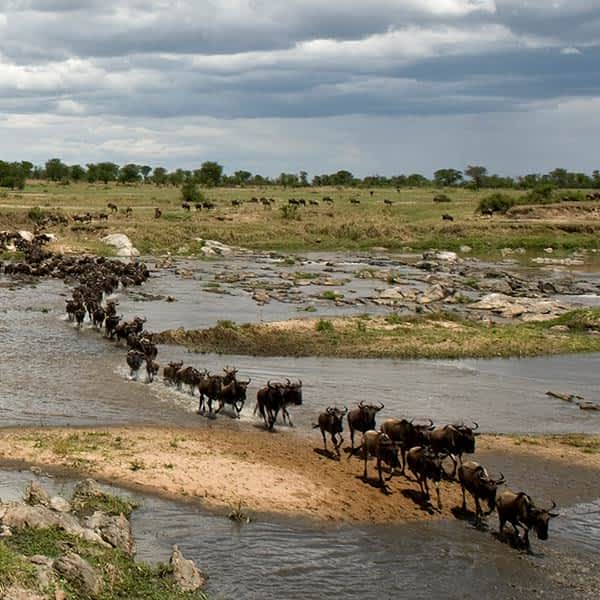
Sitting in the open-sided safari vehicle as the morning light spreads across the Serengeti, the engine moves slowly over the rough track, and dry grass brushes against the side of the vehicle where the plain seems endless. Pointing towards a dark moving line in the distance, raising your binoculars, you will see thousands upon thousands of wildebeests moving across the open grassland. This is the great wildebeest migration in Serengeti National Park, and with Sarania Adventure Safaris, you experience it from inside the landscape rather than simply watching it on a screen.
What Makes the Great Wildebeest Migration Unique?
The sound of the Serengeti
Begin your migration experience before the sunrises. You step outside your accommodation while the air is still cool; your Sarania Adventure Safaris guide prepares the vehicle as you climb inside to begin the early-morning drive. The sky slowly changes from darkness to pale gold. As the vehicle moves deeper into the Serengeti, you see zebras standing in the grass, giraffes rising above the bushes, and gazelles moving quickly across the road, whereas elephants, buffaloes, and a pride of lions rest near the grass.
Then wildebeests approach, spotted by the guide; the animals walk in groups, their heads lowered toward the grass. Some stop to graze while others continue forward as dust rises beneath their hooves as the herd passes over the plain. You can hear their calls from inside the vehicle, and at that moment, the migration stops being a picture in a travel brochure as you are physically inside it. TANAPA describes the migration as one of Serengeti’s major attractions, alongside its large predator’s populations, Big Five wildlife, birdlife, and spectacular landscape.
Across the Endless Plains
With Sarania Adventure Safaris, you follow the herd’s movements across the endless plains in respect of park rules and keeping a safe distance. The great wildebeest migration stretches across the horizon as some move in front of you, others disappear behind small hills, and a few animals cross the track and force the vehicle to stop, and you sit quietly only where the guide can safely position the vehicle as they pass.
The Serengeti landscape gives the migration its full setting as the open grasslands stretch towards rocky kopjes, while patches of woodland and river systems break the horizon. UNESCO describes the Serengeti highlights, its vast plains, rocky outcrops, rivers, and woodlands, as part of the landscape supporting this extraordinary migration. You begin to notice that every part of the landscape is connected.
The river-crossing drama
If your safari reaches the northern Serengeti during the migration period, you may have the opportunity to watch the herds approach the Mara River, and your patience becomes part of your safari. Sitting inside the vehicle, you will see the wildebeests gathering near the riverbank as the water flows below them. Then one animal steps into the water, another one follows, and suddenly the hesitation disappears. The dust rises behind them as they push towards the river, their bodies moving together, and the sound of hooves, splashing water, and animal calls reaches you from the vehicle.
The Mara River crossing is particularly associated with the northern Serengeti between roughly July and October, but the exact timing depends on rainfall and animal movement. Crossing cannot be guaranteed on a particular day because the animals decide when and where to move. Your safari, therefore, is not about chasing the animals; it is about waiting for nature to make the decision.
Experience the Calving Season
The great wildebeest migration gives you a completely different experience when you visit the southern Serengeti during the calving period, where your focus is not only on river crossing but also on the surroundings of young wildebeests. You watch a newborn calf struggling to stand as its mother remains close and nearby; hundreds of other wildebeest graze across the short grass with zebras moving among them.
The southern Serengeti becomes a nursery, and every movement around you yields a moment. Calving generally takes place around the southern Serengeti and Ndutu area during the green-season months, with January to March commonly associated with this stage of the migration. The calves must therefore become strong enough to keep up with the herds while predators take advantage of the weak young animals.
Discover That Serengeti Is More Than The Great Wildebeest Migration
The wildebeest migration may bring you to Serengeti, but it does not have to be the only reason you stay. Sarania Adventure Safaris can build your safari around several other experiences, such as game drives where you may find elephants moving through the grass, giraffes browsing on acacia trees, buffaloes gathered together, or cheetahs scanning the open plains.
TANAPA lists game drives and balloon safaris among the main activities in Serengeti National Park. Other activities include hot-air balloon safaris, wildlife photography, walking safaris, bird watching, cultural experiences, and bush meals, which allow you to experience the landscape while taking a break from the drive. Most importantly, you remember what it feels like to sit inside a moving safari vehicle while one of Africa’s greatest wildlife movements unfolds directly in front of you.
As we conclude, the great migration is not something you simply watch but rather something you follow, wait for, and listen to as you feel the movement of Serengeti around you. With Sarania Adventure Safaris, your Serengeti journey can combine the migration with game drives, photography, bird watching, balloon flights, bush meals, and other carefully planned wildlife experiences. The exact migration experience depends on the season and where the herds are moving because nature does not follow a fixed timetable.

